The first time I understood that saffron was sacred, I was not in a temple.
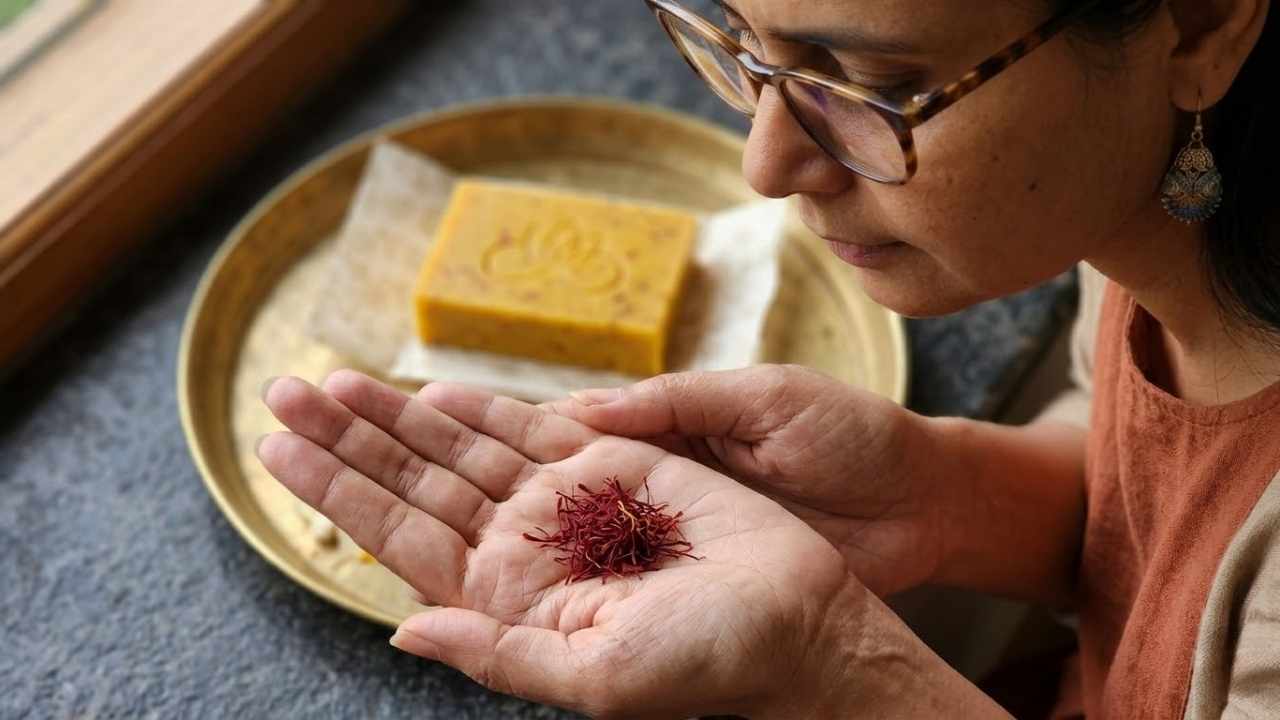
I was in my grandmother’s kitchen in Dehradun, watching her add three threads, just three, to a small bowl of warm milk. She did it the way she did everything in her morning: slowly, deliberately, as if the act itself mattered as much as the outcome. She did not measure. She did not hurry. She held the threads between her fingers for a moment before placing them in, and I remember thinking she looked like she was offering something.
She was.
Kashmiri Kesar, the real, Grade A saffron from the valleys of Kashmir, has been part of the Indian sacred morning ritual for thousands of years. Not as a luxury. As a necessity. As an ingredient that carried within it something no synthetic substitute could replicate. I did not fully understand this as a child watching through a kitchen doorway. But it is the understanding that sits at the heart of everything Avyaya makes.
What Makes Kashmiri Kesar Different From Every Other Saffron in the World
Saffron is grown in several countries: Iran, Spain, Afghanistan, and Greece. And it is perfectly possible to buy saffron from any of these origins and call it saffron.
But Kashmiri Kesar is not simply saffron. It is a specific variety, Crocus sativus grown in the Karewas, the elevated plateaus of the Kashmir Valley, at an altitude between 1,600 and 1,800 meters above sea level. The soil there is unlike any other saffron-growing region in the world. The combination of altitude, temperature variation between day and night, and the particular mineral composition of the Karewa earth produces a saffron with higher concentrations of the three compounds that make saffron genuinely powerful:
- Crocin is the pigment that gives Kashmiri Kesar its deep, almost burgundy red colour and its skin-brightening properties
- Safranal is responsible for the distinctive warm, honeyed aroma that has made saffron a ritual ingredient across Vedic, Sufi and Persian traditions alike
- Picrocrocin is the compound behind the flavour, but more relevantly for ritual use, the one that contributes to saffron’s mood-elevating and calming effects on the nervous system [Link to NCBI research on saffron and mood]
Iranian saffron, the most widely available globally, typically contains lower concentrations of all three. Spanish saffron is often harvested mechanically at scale, which damages the stigmas and reduces potency. Kashmiri Kesar is still harvested entirely by hand, at dawn, during a two-to-three-week window in October and November when the flowers bloom. Each flower produces exactly three stigmas. It takes approximately 150,000 flowers to produce one kilogram of saffron.
This is why it is priced the way it is. And this is why there is no substitute.
Five Thousand Years of Sacred Use: Kesar in Ayurvedic and Vedic Tradition
In Ayurvedic texts, saffron is classified as one of the most sattvic ingredients in existence. Sattva, the quality of purity, clarity, and luminosity, is the state that Ayurveda considers most conducive to health, spiritual practice, and conscious living. Ingredients classified as sattvic are used not just for their physical properties but for their effect on the mind and the subtle energy body. [Link to Ayurvedic classification of sattvic herbs]
The Charaka Samhita, one of the foundational Ayurvedic texts, specifically mentions saffron in preparations for skin radiance, emotional balance, and ritual purification. It was prescribed as part of snana, the sacred morning bath, and as an offering in temple rituals across India.
In Vedic tradition, Kesar paste was applied to the forehead as a tilak, a mark of auspiciousness, of divine connection, of beginning the day already aligned with something larger than the personal. In Sufi poetry, saffron appears repeatedly as a metaphor for the divine, the rare, the irreplaceable, and the thing that transforms everything it touches.
In my grandmother’s kitchen, it went into warm milk every morning without ceremony or explanation. As if it were simply understood that this was how the morning began properly.
What Grade A Actually Means and Why It Is the Only Grade Worth Using
Kashmiri Kesar is graded by the length and condition of the stigma, the thread itself.
Grade A (Mongra or Lacha): The pure deep-red stigma only. No yellow style attached. Highest concentration of crocin, safranal, and picrocrocin. This is the grade that has been used in Ayurvedic preparations and sacred rituals historically. It is what your grandmother used, if she knew her saffron.
Grade B: The stigma with some yellow style attached. Visually similar to Grade A but meaningfully lower in potency and color yield.
Grade C and below: Largely style and filler. Often what you find in supermarket saffron at suspiciously low prices.
The difference in ritual and skincare application is not subtle. Grade A Kashmiri Kesar releases a deep amber-gold color in warm water within minutes. Lower grades take longer and yield a paler, weaker infusion. For a sacred morning ritual where the intention is to use something pure and potent, the grade is not a luxury consideration. It is a basic one.
The Skin and Soul Benefits of Kashmiri Kesar in Your Morning Ritual
This is where ancient wisdom and modern research have quietly arrived at the same place.
For the skin:
Crocin, the primary pigment in Kashmiri Kesar, has been shown in multiple studies to inhibit melanin production, making it genuinely effective for brightening, evening skin tone, and reducing hyperpigmentation with consistent use. [Link to NCBI study on crocin and skin brightening] It is also a powerful antioxidant, protecting skin cells from oxidative stress, the primary driver of premature aging. Safranal has demonstrated anti-inflammatory properties, making saffron useful for sensitive or reactive skin.
For the mind:
Research into saffron’s effect on mood is among the most compelling in natural ingredient science. Multiple clinical studies have shown that regular exposure to saffron’s active compounds, even aromatically, can meaningfully reduce symptoms of anxiety and low mood. [Link to NCBI meta-analysis on saffron and mood] This is not new information to Ayurveda, which has prescribed saffron for emotional balance for millennia. It is simply new to the scientific method.
For the ritual:
The aroma of genuine Kashmiri Kesar in warm water is unlike anything else in the natural world. It is warm, honeyed, faintly floral, and deeply grounding all at once. In a sacred morning ritual, it does something that no clinical study has yet fully measured: it arrives to you. It pulls you into the present moment through the oldest human faculty: smell. Your morning, from the first breath of it, becomes something worth inhabiting.
How to Spot Fake Saffron and Why It Has No Place in a Sacred Practice
Because saffron is among the most expensive ingredients in the world by weight, adulteration is widespread. Here is what to look for:
Color release: Place a few threads in warm, not boiling, water. Real Kashmiri Kesar releases a slow, deep amber-gold over 10 to 15 minutes. Fake or adulterated saffron releases color immediately and turns the water an artificial, uniform red-orange.
The thread itself: Real Grade A stigmas are deep burgundy-red, slightly trumpet-shaped at the tip, and completely dry and brittle. Dyed corn silk, safflower, or paper fibers are sometimes sold as saffron; they will feel slightly different in texture and release color too uniformly.
The smell: Genuine Kashmiri Kesar has a warm, complex, slightly medicinal aroma. Fake saffron often smells of nothing or of artificial floral fragrance.
The price: If it is cheap, it is not real. There is no version of this where the economics work otherwise. 150,000 flowers. Two weeks. Entirely by hand. At altitude. Grade A Kashmiri Kesar cannot be inexpensive and remain what it is.
For a sacred morning ritual, using adulterated saffron is not a neutral compromise. It is using the wrong ingredient entirely, one that carries none of the properties, none of the history, and none of the intention that makes Kesar worth including in the first place.
How Avyaya Uses Kashmiri Kesar and Why We Will Never Compromise on This
When I began formulating the Swarna Shuddhi Bar, our Haldi Chandan Kesar Soap—the question of saffron grade was never a cost conversation. It was a values conversation.
Everything in Avyaya’s sourcing philosophy begins with one question: would my grandmother have accepted this? Not as nostalgia. As a standard. She knew her Kesar by sight, by smell, and by the color it released in warm water. She would not have used anything less than the real thing in her morning, and she would not have understood why anyone would.
Every Swarna Shuddhi Bar is made in small batches with Grade A Kashmiri Kesar sourced directly, verified for authenticity, and used in quantities that are meaningful rather than token. It is prepared in a conscious, devotional environment so that the intention of the making is present in the product you receive. Because in Ayurvedic tradition, bhavana, the energy and intention of the maker, is as much a part of the preparation as the ingredients themselves.
The result is a soap that does what saffron has always done in an Indian sacred morning ritual: it brightens, it grounds, and it arrives you in your own skin.
That is not a skincare claim. It is a very old truth.
If you would like to bring Kashmiri Kesar into your morning ritual, the Swarna Shuddhi Bar is here.
Frequently Asked Questions
Can I use saffron on my skin every day?
Yes, and in Ayurvedic tradition, daily use is precisely the point. The benefits of Kashmiri Kesar on skin are brightening, antioxidant protection, and anti-inflammatory action, built with consistent use over time. A ritual performed daily compounds. This is true of saffron on the skin exactly as it is true of any sacred morning practice.
Is Kashmiri Kesar safe for all skin types?
Kashmiri Kesar is one of the most gentle and universally suitable Ayurvedic ingredients, classified as sattvic and balancing across all three doshas: Vata, Pitta, and Kapha. It is particularly beneficial for dull, uneven, or sensitive skin. As with any new ingredient, a small patch test before full use is always sensible.
Why does Avyaya use saffron in a soap rather than a serum?
Because the ritual of bathing, snana, is where saffron has always belonged in Indian sacred tradition. A serum is a product. A soap used in a conscious morning ritual is a practice. Avyaya is built around the practice, not the product format. The Swarna Shuddhi Bar is designed to be used slowly, deliberately, and with intention, exactly as my grandmother used her three threads of Kesar every morning. Read the full story of why Avyaya was built this way.