The word “swarna” means golden. The word “shuddhi” means purification. Together, Swarna Shuddhi describes a practice that Indian tradition has placed at the beginning of auspicious occasions for over five thousand years—the application of sacred golden ingredients to the body before prayer, before ceremony, before any beginning that matters.
This is the Abundance ritual. Not a ritual about getting more. A ritual about becoming the quality of person—radiant, open, generous, intentional—to whom abundance naturally moves.
What the Swarna Shuddhi practice actually is
In Vedic tradition, the preparation of the body before a ceremony was considered as important as the ceremony itself. You could not offer prayers in a state of mental fog, physical heaviness, or spiritual contraction. The body had to be prepared and purified before it could become a clear vessel for intention.
The Swarna Shuddhi practice uses three specific ingredients for this preparation: haldi (turmeric), chandan (sandalwood), and kesar (saffron). These three are not chosen arbitrarily. Each has a specific role in the transformation of the practitioner’s state from ordinary to ceremonial.
Turmeric is the purifying ingredient that, applied to the body, signals transition. In Indian weddings, the haldi ceremony comes before the wedding itself, not after. The bride and groom are purified by the golden paste before they cross the threshold into their new life. Turmeric does not simply clean the skin. It marks a passage.
Sandalwood is the quieter ingredient that shifts the quality of the mind from scattered to focused. As detailed in Avyaya’s ingredient glossary, sandalwood’s alpha-santalol compound has documented effects on the nervous system that create the conditions for clear intention-setting.
Saffron is the invoker, most sacred and expensive spice in India, offered to Lakshmi in temples, a symbol of divine presence and prosperity. Grade A Kashmiri kesar, the only saffron Avyaya uses, carries this ritual lineage. When you apply it to your body, you are participating in a gesture of invocation that spans millennia.
What you need for the abundance ritual
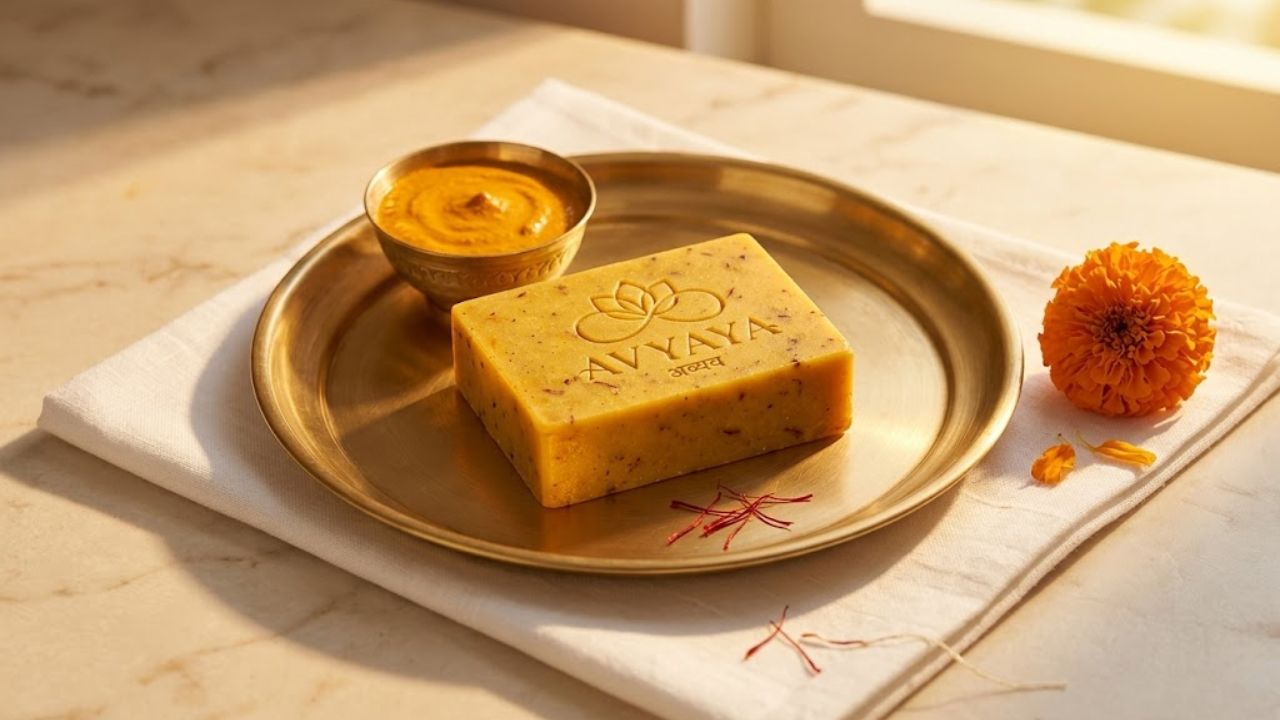
- Avyaya Haldi Chandan Kesar Soap (Swarna Shuddhi Bar)
- Avyaya Manifestation Candle (optional but recommended)
- Five uninterrupted minutes
- A clear intention — stated in the language of becoming, not acquiring
That last point is important and worth expanding. The abundance ritual does not work with intentions framed as lack. “I want more clients” is an intention framed from scarcity. “I am becoming someone whose work calls the right people to it” is the same desire framed from fullness. The Vedic understanding of abundance is that prosperity flows toward those who embody the qualities of openness and generosity—not toward those who grasp.
Before you step under the water, decide what quality you are invoking. Not what you want to get. What you want to become.
Step-by-step: how to perform the Swarna Shuddhi Abundance Ritual
Step 01—Prepare the space
If you are using the manifestation candle, light it now, before the shower. Hold it in both hands for thirty seconds and speak your intention aloud. The voice carries intention in a way that thought does not—there is neuroscientific evidence that self-verbalization activates different neural pathways than silent thought alone. You are not performing for an audience. You are making your intention real to your own nervous system.
Place the candle somewhere you can see it when you return.
Step 02 — Hold the soap before you lather
Step into the shower but do not reach for the soap immediately. Stand under the warm water for thirty seconds. Let it begin its work. Then pick up the Haldi Chandan Kesar Soap and hold it in both hands. Inhale. The sandalwood and saffron scent is not decoration — it is information to your nervous system that something different from an ordinary shower is about to happen. Let it register.
Step 03 — State your intention
Aloud—always aloud—state what you are invoking. Not what you want. What you are becoming. One sentence. Spoken twice. The repetition is deliberate: the first time you speak it, you are saying it. The second time, you are beginning to believe it.
Step 04—Lather from the heart outward
Begin at the chest—the heart center—and move outward toward the limbs. This direction is traditional in Ayurvedic self-massage (abhyanga) and carries the intention outward from your core into the world. This is not a rule. It is a practice. Do it consciously and notice whether it feels different from an ordinary shower.
Step 05 — Rinse with intention
As you rinse, do not think of the water as washing the soap away. Think of it as carrying your intention into the world. This is what golden water means in the context of Swarna Shuddhi — the water that leaves your body is charged with the intention you set. You are not draining something away. You are sending something out.
Step 06—Read your affirmation card
The Clarity Affirmation Card included with your order is your final act. Read it aloud. Three times. Once to hear it. Twice to feel it. Three times to let it settle.
When to perform the abundance ritual
The Swarna Shuddhi practice is most potent at three times: early morning before important work, before any auspicious beginning (a new project, a significant meeting, a major decision), and on days of Vedic significance such as Akshaya Tritiya, Dhanteras, or any new moon.
It can also be performed simply on any morning when you intend to move toward something significant. The ritual does not require a special occasion. The intention creates the occasion.
What to do after the abundance ritual
Do not immediately look at your phone. Give the ritual five minutes to settle before you re-enter the ordinary world. Sit with the Manifestation Candle if it is still burning. Write down your intention on a small piece of paper and place it beside the candle. The practice of externalizing intention—writing it, placing it, and witnessing it—is documented in the research on self-affirmation to reinforce neural commitment to the stated goal.
The ritual is complete. The day has been prepared.
But here is what the Vedic tradition understood that modern productivity culture does not: the work of the ritual is not finished when you leave the bathroom. The Swarna Shuddhi practice is not a morning hack. It is the first act of a day lived with full presence. Every decision you make after it, every conversation you enter, and every piece of work you put your hands to—these are continuations of the ritual. The golden quality you invoked does not stay in the shower. You carry it out with you.
This is what abundance actually means in practice. Not a number in an account. Not a result waiting to arrive. A quality of being that you return to every morning, one sacred act at a time.
Ready to begin the Swarna Shuddhi practice? The Haldi Chandan Kesar Soap is handcrafted in small batches with Grade A Kashmiri kesar, single-origin Erode turmeric, and pure sandalwood—and arrives with an affirmation card chosen for the abundance ritual.