There is a particular kind of tired that sleep does not fix.
You know it. The tiredness that is still there when you wake up. The fatigue that has settled into your shoulders and your jaw and the space behind your eyes—the kind that a good night’s sleep moves around but never actually removes. The kind that has been accumulating, quietly and persistently, for months or years.
For most of my corporate life, I treated this tiredness as a condition of existence. The price of ambition. Everyone I knew was tired in the same way. We wore it like a badge—proof that we were working hard enough, caring enough, and doing enough.
It was only in Dehradun, in the particular stillness of a mountain evening, that I encountered a completely different idea. Not the idea that I needed more sleep. The idea that I had never actually rested. And that the Ayurvedic rest ritual—the conscious, intentional practice of restoration that Indian tradition has prescribed for thousands of years—was the one practice I had been refusing my entire adult life.
This article is for everyone who is tired in the way that sleep does not fix.
The Ayurvedic Rest Ritual Begins With Understanding Your Rhythm
In Ayurvedic philosophy, rest is not the absence of activity. It is a specific, active state—the conscious practice of tamas being metabolized into sattva. Let me explain what that means.
Ayurveda describes three fundamental qualities—gunas—that govern all of nature and all human experience. Rajas is the quality of activity, movement, and passion. Tamas is the quality of inertia, heaviness, and darkness. Sattva is the quality of clarity, lightness, and consciousness.
Modern life runs almost entirely on rajas—constant movement, constant stimulation, and constant output. When rajas is not balanced with conscious rest, it collapses into tamas—not the restorative darkness of deep sleep but the exhausted, heavy inertia of a system that has been pushed past its capacity. This is the tiredness that sleep does not fix. It is tamas that has accumulated faster than the body can process it.
Ayurvedic research on tamas, rajas and health
The Ayurvedic rest ritual is the prescribed antidote. Not passive collapse in front of a screen. Not the unconscious shutdown of exhaustion-driven sleep. Conscious, intentional restoration — a practice performed with as much deliberateness as the morning ritual that begins the day.
Dinacharya — Ayurveda’s daily routine framework — gives as much attention to the evening as to the morning. The evening is not the tail end of the day. It is the beginning of the next one. How you close the day determines the quality of the sleep that follows, the quality of the morning that emerges from that sleep, and ultimately the quality of the entire next day.
NCBI research on evening routine and sleep quality
In Ayurvedic understanding, rest is not what happens when you stop. It is what you prepare for.
Why Modern Life Has Made Rest Feel Shameful
Before we can perform the Ayurvedic rest ritual, we need to address the thing that prevents most people from resting at all: guilt.
Rest guilt is almost universal among high-functioning people. The feeling that stopping is falling behind. That stillness is laziness in disguise. That the body asking for rest is a weakness to be managed rather than a wisdom to be honored.
This is not a personal failing. It is a cultural one. The productivity ethic that dominates modern professional life — particularly in India’s aspirational urban culture — is built on the implicit premise that output equals worth. If you are resting, you are not producing. If you are not producing, you are not valuable. The body’s signals for rest are overridden, ignored, or treated as inconveniences.
Ayurveda has a completely different framework. In Vedic philosophy, the body is not a machine to be optimized. It is a sacred vessel—the deha, the physical home of the atma (soul)—that requires tending, nourishment, and genuine restoration to perform its function with integrity.
Ayurvedic philosophy on the body as sacred vessel
Refusing rest, in Ayurvedic terms, is not discipline. It is prajnaparadha—translated as “the crime against wisdom.” The deliberate overriding of the body’s own intelligence. And like all crimes against wisdom, it accumulates consequences that eventually cannot be ignored.
The Ayurvedic rest ritual begins with a single permission: I am allowed to stop.
The Ayurvedic Rest Ritual — What Dinacharya Prescribes for the Evening
Classical Ayurvedic texts describe the ideal evening as a mirror of the morning — a deliberate transition from the activity of the day back to the stillness from which tomorrow will emerge. The evening dinacharya has five specific elements:
1. The closing of the day’s work (karma samapti)
Ayurveda prescribes a conscious moment of closure — acknowledging what was accomplished, releasing what was not, and mentally setting down the day’s responsibilities before the body begins its transition to rest. In practical terms: a moment at the end of the workday—not at midnight after two hours of scrolling—where you consciously say: the work day is complete.
2. The evening meal (ratri bhojana)
Ayurveda recommends the evening meal be lighter than the midday meal and completed at least two to three hours before sleep. The digestive fire (agni) reduces in the evening, and heavy food consumed late creates ama — undigested residue — that disrupts sleep and contributes to the morning heaviness that the Ayurvedic rest ritual is designed to prevent. [Link to Ayurvedic research on agni and evening digestion]
3. The evening bath (sandhya snana)
A warm bath in the evening is prescribed in Ayurvedic dinacharya as the physical signal to the nervous system that the day is ending. Different from the morning snana—which is energizing and protective—the evening bath is designed to release the day’s accumulation from the body and prepare the nervous system for genuine rest. This is the moment for the Ayurvedic rest ritual’s physical practice.
4. The oil application (abhyanga)
Warm oil applied to the soles of the feet before sleep is one of Ayurveda’s simplest and most consistently prescribed practices for improving sleep quality. Pada abhyanga—foot massage—directly stimulates the parasympathetic nervous system, reduces cortisol, and signals to the body that it is safe to enter deep rest. [Link to NCBI research on foot massage and sleep quality]
5. The evening affirmation (ratri sankalpa)
The final act of the Ayurvedic rest ritual is the spoken intention of release—the conscious declaration that the day is complete, that what was not finished will wait, and that the body has full permission to rest. This is not positive thinking. It is the energetic seal that closes the day the way the morning affirmation opens it.
The Sacred Ingredients of Rest — What Belongs in Your Evening Practice
Ayurveda is specific about the ingredients that support the Kapha and Vata pacification required for genuine rest. Two of them sit at the heart of the Avyaya Rest collection.
French Lavender Essential Oil
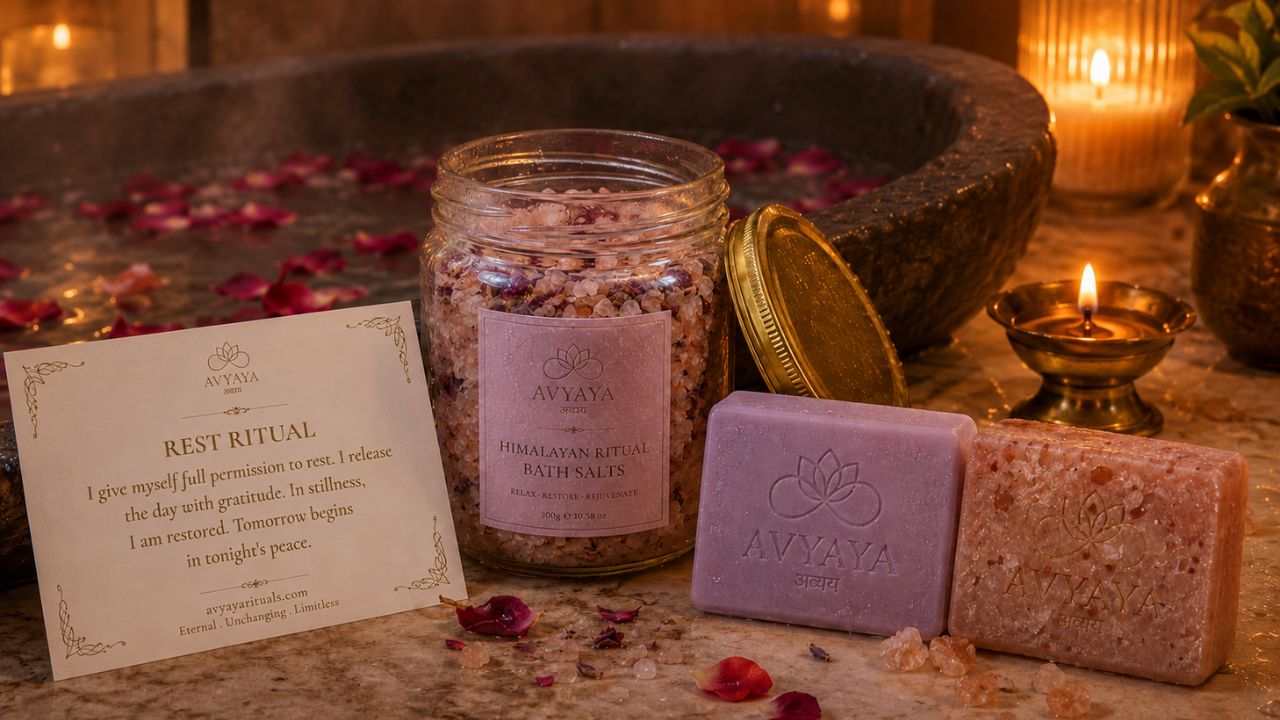
Lavender is the most clinically studied natural sleep aid in existence. Its documented effect on the parasympathetic nervous system—slowing heart rate, reducing cortisol, and signalling to the body that it is physiologically safe to rest—has been replicated across multiple peer-reviewed studies. [Link to NCBI meta-analysis on lavender and sleep] In Ayurvedic terms, lavender is deeply Pitta-pacifying — cooling the excess heat and agitation that keeps the overworked mind from settling. The Avyaya Lavender Calming Soap was designed specifically as an evening bar — French lavender from Provence, chamomile for Pitta pacification, and shea butter for the deep overnight nourishment the skin absorbs as you sleep. Use it as the physical centerpiece of your evening sandhya snana—the Ayurvedic rest ritual’s bathing practice.
Himalayan Pink Salt — 84 Trace Minerals
The Ayurvedic tradition of mineral bathing—lavana snana—uses salt to draw accumulated ama (toxins and energetic residue) from the body through osmosis while simultaneously replenishing the trace minerals depleted by a day of physical and mental exertion. Himalayan pink salt contains 84 trace minerals, including magnesium, the mineral most associated with nervous system regulation and sleep quality in modern research.
NCBI research on magnesium and sleep
The Avyaya Himalayan Ritual Bath Salts—rose petals, marigold, lavender, and geranium essential oils—transform the evening bath into a complete mineral restoration ceremony. Use them once a week, on the evening you most need the deepest reset.
Every Avyaya Rest collection product arrives with its affirmation card—visit the Avyaya Affirmation Universe to explore the complete rest intentions.
How to Perform the Complete Ayurvedic Rest Ritual — Step by Step
What you need: Your Avyaya Lavender Calming Soap, warm bath water, your affirmation card, one small candle or diya, optional — Himalayan Ritual Bath Salts for the weekly deep ceremony
Time: 15–20 minutes
Step 1: Close the day consciously
Before beginning the physical ritual, sit or stand still for one full minute and consciously close the workday. This is not meditation — it is a deliberate mental act. Name three things that were completed today. Release one thing that was not. Set it down. The Ayurvedic rest ritual begins in the mind before it begins in the body.
Step 2: Draw the bath with intention
Run warm (not hot) water. As the bath fills, exhale three times with full intention—releasing the day with each breath. If you are using the Himalayan Ritual Bath Salts tonight, add two generous handfuls as the water runs and watch the petals float. Light a small candle or diya beside the bath.
Step 3: Enter the water deliberately
Step in slowly. Stand still for a full breath before reaching for anything. Allow the warmth to begin the work of releasing the day’s physical tension—the shoulders, the jaw, the space behind the eyes. The body knows how to rest. Your only job in this moment is to stop preventing it.
Step 4: Lather with the Lavender Calming Soap slowly
Take the Lavender Calming Soap and lather from the shoulders downward, releasing tension as you go. As you wash, hold one intention: I am releasing the day. Not reviewing it, not planning tomorrow—releasing it. The lavender fragrance will do its work on your nervous system whether or not you direct it to. But the intention deepens the practice.
Step 5: Soak for at least ten minutes
This is the step most people skip. Ten minutes is the minimum time required for the parasympathetic nervous system to genuinely shift state in warm water. If you are using the Himalayan Bath Salts, twenty minutes allows the minerals to begin their osmotic work through the skin. Place your affirmation card where you can read it from the water.
Step 6: Read your affirmation and close with gratitude
Before stepping out, read your affirmation card aloud three times:
“I give myself full permission to rest. I release the day with gratitude. In stillness, I am restored. Tomorrow begins in tonight’s peace.”
Close with three words: thank you. To your body, for carrying the day. To the evening, for arriving. To the practice, for being here every night without exception.
Emerge slowly. Rest for at least ten minutes after the bath before sleep — the body is most receptive in this window. Apply warm oil to the soles of your feet if you have it. Then sleep.
What Happens to the Body and Mind When You Finally Rest With Intention
The first night of the Ayurvedic rest ritual will feel different from your usual evening. The sleep that follows it will be different too — not necessarily longer, but deeper. More complete. The particular kind of sleep where you wake up and for a moment, before the day reassembles itself, there is genuine stillness.
That stillness is sattva. The quality that Ayurveda says the morning ritual is designed to protect and the evening ritual is designed to restore. It is not a luxury. It is the baseline state from which clear thinking, genuine creativity, and real resilience emerge.
Over thirty days of the Ayurvedic rest ritual — performed consistently, not perfectly — something shifts in the baseline. The tiredness that was always present begins to reduce. Not dramatically, not all at once. But the accumulated tamas that had been building for months or years begins to metabolise. The morning tightness in the shoulders begins to release. The low-grade anxiety that had become background noise begins to quiet.
This is not the soap. This is not the bath salts. This is you — finally, deliberately, with full intention — giving your body what it has been asking for.
Ayurveda has always known that rest is medicine. The most powerful medicine, in fact, for the particular exhaustion of the modern life. The one you have been refusing.
You do not have to refuse it tonight.
Begin your Ayurvedic rest ritual with the Avyaya Rest collection — the Lavender Calming Soap and Himalayan Ritual Bath Salts, each arriving with their affirmation card. Handmade in small batches with the care that genuine rest deserves.
FAQ
What is an Ayurvedic rest ritual?
An Ayurvedic rest ritual is a deliberate, multi-step evening practice rooted in the principles of dinacharya—the Ayurvedic daily cycle. Rather than simply stopping activity, it uses warmth, sacred botanicals, breath, and affirmation to actively transition the nervous system from the stimulation of the day into a state of deep restoration. It is medicine practiced through intention.
What time should the Ayurvedic rest ritual be performed?
Ayurvedic dinacharya recommends beginning the evening wind-down no later than 9 PM — ideally between 7 PM and 9 PM when Kapha energy naturally begins to rise and the body’s inclination toward rest is at its strongest. Starting the ritual within this window allows you to work with your body’s natural rhythm rather than against it. If you begin after 10 PM, vata begins to dominate again, making it harder to settle the mind and achieve genuinely restorative sleep.
How often should I perform this rest ritual?
The full three-phase ritual is designed to be performed once a week—particularly the Himalayan Salt Detox Soap phase, which is a deep mineral cleanse and should not be used daily. The Lavender Calming Soap closing practice, however, can and ideally should be used every evening as a nightly ritual signal to your nervous system. The Himalayan Ritual Bath Salts are best used one to three times a week depending on your schedule and need for deep restoration.
Can I do this ritual if I only have a shower and no bath?
Yes. For the Himalayan Ritual Bath Salts, you can dissolve two handfuls in a large basin of warm water and soak your feet for at least 20 minutes while seated in stillness—this is a fully valid Ayurvedic foot bath practice and carries significant grounding benefit on its own. The Himalayan Salt Detox Soap and Lavender Calming Soap work entirely in the shower and require no modification.
What if I only have 10–15 minutes in the evening?
Use the Lavender Calming Soap alone as your closing ritual. Even a single conscious act — washing with warm water, breathing in the lavender, and speaking your affirmation — sends a powerful signal to the body. Ayurveda does not require perfection. It asks only for presence. A short ritual done with full intention is far more powerful than a complete ritual done on autopilot.
Why is the Himalayan Salt Detox Soap used weekly and not daily?
Himalayan Pink Salt is a deep purifying mineral. Used too frequently, it can strip the skin’s natural protective barrier and over-stimulate the lymphatic system. Ayurveda has always understood that cleansing is most effective when it is periodic—just as the body needs time to rebuild after a fast, it needs recovery time between deep mineral purges. Weekly use ensures the cleansing is thorough, the skin remains balanced, and the ritual retains its potency.
Can I use all three products in a single evening?
Yes, and this is the full three-phase ritual as designed. Begin with the Himalayan Salt Detox Soap for the weekly purge, follow with the Himalayan Ritual Bath Salts soak, and close with the Lavender Calming Soap. Performed together, they create a complete Ayurvedic arc: release, restoration, and sealing. Allow yourself 45 to 60 minutes for the full practice. Reserve this for one evening per week when you have the time and space to do it without rushing.
What is the significance of saying the affirmation out loud?
In Ayurvedic and Vedic tradition, spoken intention—sankalpa—carries a different quality than silent thought. When you speak an affirmation aloud, you engage the breath, the vocal body, and the auditory nervous system simultaneously. You hear your own words, and the body responds differently to what it hears than to what it merely thinks. Each Avyaya product comes with its own affirmation card designed for this moment. Place it where you can read it clearly and speak it with conviction—not as a performance, but as a genuine act of permission and care for yourself.
Is this ritual suitable for all Ayurvedic body types (doshas)?
Yes. While the ritual has particular benefit for vata-dominant individuals whose nervous systems tend to run fast and overstimulated, it is grounding and restorative for all three doshas. Pitta types will benefit greatly from the cooling properties of Himalayan Salt and the soothing quality of Chamomile in the Lavender soap. Kapha types may find the Peppermint in the Himalayan Salt Detox Soap especially invigorating, offering a sense of clarity before the deeper restoration begins.
How long before I notice a difference?
Most people notice a shift in sleep quality within three to seven days of consistent evening ritual practice. Deeper changes — in skin, mood, energy levels, and mental clarity — typically emerge within three to four weeks. Ayurveda works cumulatively. The body responds to consistent signals over time. The ritual builds a conditioned response: after a few weeks, your nervous system begins preparing for rest the moment you begin your practice. This is the compounding gift of dinacharya.