Evil eye protection has been practiced across India for thousands of years—long before it had a name, long before it became a ritual, long before anyone needed to explain why certain people leave you feeling lighter after a conversation and others leave you feeling as though something has been quietly taken.
You know both types. Most of us do. We have walked away from certain interactions feeling inexplicably flat, drained, or vaguely unsettled—without being able to point to a single thing that was said or done.
For most of my adult life I filed this in the category of “personality chemistry” and moved on. It was only when I returned to Dehradun—when the pace of my life finally slowed enough to let me pay attention—that I understood what these exchanges actually were. And what I found was not a new idea. It was one of the oldest in the world.
It is called nazar. And this is your complete guide to understanding it — and protecting yourself from it every single day.
What Nazar Actually Is — Beyond Superstition
The word “nazar” comes from the Arabic and Urdu root meaning “gaze” or “sight.” In common usage across India, the Middle East, and the Mediterranean, it refers to the evil eye—the belief that a concentrated gaze of envy, admiration, or ill-will can transmit negative energy to the person, object, or situation being looked upon.
Most modern, educated people encounter this concept and immediately file it under superstition. A cultural holdover. Something grandmothers believe and scientists dismiss.
But the dismissal is too quick. And it misunderstands what “nazar” actually describes.
Nazar is not a magical curse delivered through a glance. It is the energetic residue of a concentrated emotional state—envy, covetousness, excessive admiration—directed with intensity toward another person. In Vedic understanding, thought and emotion carry prana—life force—and concentrated emotional energy directed outward has a measurable effect on the recipient’s energy field.
Research on psychophysiological effects of social evaluation
This is not uniquely Indian. The evil eye belief—in remarkably consistent form—appears in ancient Greek and Roman texts, in the Hebrew Bible (ayin hara), in Islamic tradition (al-ayn), in Turkish (nazar), in Italian (malocchio), in Mexican (mal de ojo), and across virtually every sub-Saharan African tradition. When a belief appears independently across cultures that had no contact with each other, the honest intellectual position is not dismissal but curiosity.
Something real is being described. The traditions simply name it differently.
Why the Evil Eye Belief Spans Every Culture on Earth
The anthropological consensus on the evil eye is quietly fascinating. Researchers studying the cross-cultural prevalence of this belief have consistently found that it clusters around three conditions: situations of visible prosperity or good fortune, situations of public admiration or praise, and situations of social comparison where envy is the natural human response. [Link to NCBI anthropological research on evil eye cross-cultural prevalence]
This is not coincidence. These are precisely the situations in which concentrated negative emotional energy—envy, resentment, and excessive admiration that tips into covetousness—is most likely to be directed toward another person.
In Vedic tradition, even positive but excessive admiration (ati-drishti—literally “overlooking”) is considered a form of nazar. This is why Indian parents traditionally avoid excessive public praise of their children—not from false modesty, but from a genuine understanding that concentrated attention of any intense variety carries an energetic charge. Why a new home, a new business, or a new relationship is protected with ritual before being shown to the world? Why the kaala teeka — the black dot — is applied to ward off the evil eye before an auspicious occasion.
The protection comes first. Then the visibility.
How Nazar Affects Your Energy Field — The Vedic Explanation
In Vedic and Ayurvedic understanding, the human being exists simultaneously on multiple levels — the physical body (sthula sharira), the subtle body (sukshma sharira), and the causal body (karana sharira). The subtle body is the energetic template that underlies physical health and mental well-being. It is permeable—it receives and transmits energy through interaction, environment, and the concentrated attention of others.
When nazar lands on the subtle body, it creates what Ayurveda calls dosha imbalance at the energetic level—a disturbance in the smooth flow of prana that can manifest as inexplicable fatigue, sudden loss of confidence, disrupted sleep, or a vague but persistent sense of being off-center. None of these symptoms have a physical cause. But they are real. And they respond to energetic, not pharmaceutical, treatment. [Link to Ayurvedic research on subtle body and prana]
The Ayurvedic prescription for nazar is not passive. It is active, daily, and physical — a ritual of energetic protection performed every morning before the day’s interactions begin. Not because every interaction carries nazar. But because a protected energy field is simply less permeable to whatever it encounters. The way a well-nourished immune system is not immune to every virus but handles encounters with them more effectively.
Evil eye protection, in Ayurvedic tradition, is immune support for the subtle body.
The Daily Evil Eye Protection Ritual — What Ancient Tradition Prescribes
Classical Indian protective rituals for nazar fall into three categories—each targeting a different aspect of the energetic vulnerability:
Space clearing (dhoop):
Burning protective resins and herbs — frankincense (loban), neem, and black pepper — in the home and on the body to create an energetic barrier. The smoke of these substances has been used across Vedic, Islamic, and Christian ritual traditions for purification and protection. [Link to NCBI research on frankincense and antimicrobial properties]
Physical sealing:
The application of protective substances to the body—most commonly black (kaala) ingredients, which in Vedic color theory carry the energetic quality of absorption and protection. Black tourmaline, black sesame, and activated charcoal all belong to this category in ritual use. The morning bath (snana) with protective ingredients is the Ayurvedic equivalent of sealing the aura before the day begins.
Intention and affirmation (sankalpa):
The spoken declaration of protection — setting the energetic boundary through voice and intention before entering the day’s interactions. In Vedic tradition, the spoken word (vak) carries creative force. A protection affirmation spoken aloud in a prepared body is understood to create a literal energetic seal.
The complete daily evil eye protection ritual combines all three — smoke, physical application, and spoken intention — into a five-minute morning practice that prepares the subtle body for whatever the day brings.
The Ingredients of Genuine Evil Eye Protection
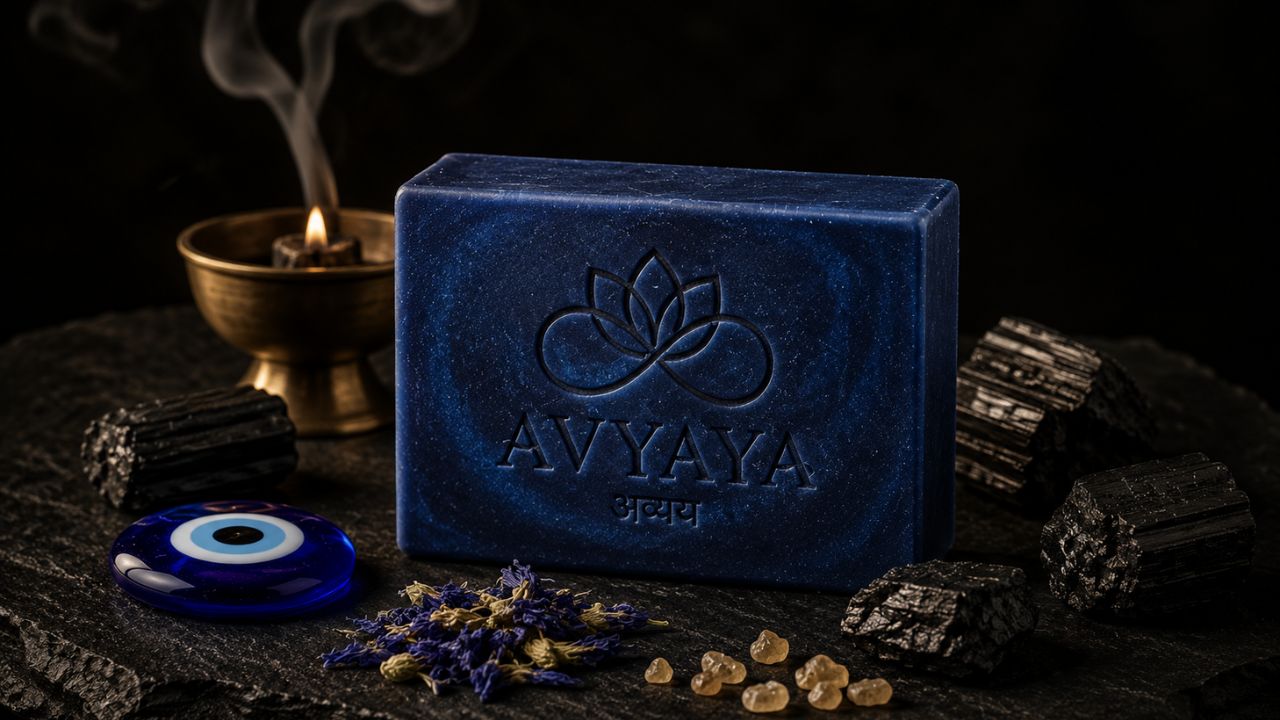
When I began formulating the Avyaya Evil Eye Protection Soap, the ingredient selection was not aesthetic. Each one was chosen because it belongs to the protection tradition—not because it photographs beautifully (though the deep navy of this bar is unmistakable).
Black Tourmaline Chips
One of the most revered protective substances in crystal healing and energy work across traditions. Black tourmaline grounds electromagnetic energy, creates an energetic barrier, and is used by energy practitioners worldwide as a protection tool. In this bar, you apply its protective energy directly to your body during the morning ritual—not carried in a pocket or placed at a doorway, but absorbed into the skin as a physical act of sealing. [Link to research on tourmaline piezoelectric properties]
Blue Indigo Powder
In virtually every tradition where evil eye protection is practiced, blue is the protective color—the blue of the Turkish nazar boncugu (evil eye amulet), the blue of the hamsa, the blue of the third eye chakra (ajna) which governs perception and intuition. Blue indigo powder carries this protective energetic alignment while performing deep physical cleansing of the skin—drawing out impurities at the pore level while the intention of the practice works at the energetic level.
Frankincense Essential Oil
Used in temple purification rituals for thousands of years across Egypt, India, and the Middle East, Boswellia has one of the longest documented histories of sacred protective use of any ingredient in the world. Its resinous, grounding fragrance elevates the energetic frequency of both the space and the body, creating a vibrational field that Vedic tradition understands as genuinely repellent to lower-frequency negative energies. Modern research has documented its anxiolytic and anti-inflammatory properties — the physical correlate of its traditional calming and protective use. [Link to NCBI research on Boswellia and anxiolytic properties]
Gangajal — The Holy Water of the Ganga
No ingredient in the Indian sacred tradition carries a more universally recognized protective authority than Gangajal—the sacred water of the River Ganga. Revered for thousands of years across Hindu, Ayurvedic, and Vedic traditions, Gangajal is used in every major ritual of purification—from temple abhisheka to the last rites—precisely because of its understood capacity to neutralize negative energy, block spiritual attacks, and cleanse the subtle body of accumulated impurity.
In Ayurvedic literature, the Ganga is described as “papa-nashini“—the destroyer of accumulated karmic and energetic residue. Water from the Ganga has been documented to contain unique antibacterial properties that science has not yet fully explained — a quality Indian tradition has always attributed to its sacred origin.
Research on Gangajal antimicrobial properties
In the Avyaya Evil Eye Protection Soap, Gangajal is the ingredient that elevates this bar beyond a protection ritual product into something genuinely sacred. It is the element that connects your daily morning practice to the most ancient stream of Indian protective tradition. When you lather with this bar, you are not simply using an energetically protective ingredient — you are bringing the living memory of the Ganga into your bathroom and your aura.
Every bar of the Evil Eye Protection Soap is prepared in small batches, in a devotional environment, with protection intention set before the making begins. Bhavana—the Ayurvedic principle that the maker’s intention transfers into the preparation—means that what arrives in your hands has already been held with the specific intention of protection.
How to Perform Your Daily Evil Eye Protection Ritual — Step by Step
What you need: Your Avyaya Evil Eye Protection Soap, warm water, your affirmation card, optionally, a piece of frankincense resin or the Avyaya Protection Incense
Time: 5–7 minutes
Step 1: State your intention before touching the water
Before beginning the physical ritual, stand still for one breath and state your protection intention clearly—not in your mind, but aloud. Even one sentence: “I protect my energy today.” The voice activates the intention. The body hears it.
Step 2: Light your protection incense if you have it
The Protection incense from the Avyaya Sacred Incense Set—frankincense, myrrh, and black pepper—creates the energetic seal in your space before you seal your body. Allow the smoke to move through the bathroom for one minute before you begin the bath.
Step 3: Hold the soap and feel its weight
Before lathering, hold the Evil Eye Protection Soap in both hands for a moment. Feel its weight—deep, grounding, solid. This deliberate pause activates the intention of the practice before the physical cleansing begins.
Step 4: Lather with directional intention
As you lather, visualize a deep navy shield of light forming around your entire body—beginning at the crown of your head and moving downward to your feet. In Vedic energetic mapping, the back of the neck and the base of the spine are the most energetically vulnerable points—give these extra attention and extra intention.
Step 5: Seal the ritual
After rinsing, cross your arms briefly over your chest and read your affirmation card aloud three times:
“My energy is my own. I am surrounded by a shield of divine light that only love may enter. I release all that is not mine to carry.”

Close with the gesture of crossing your arms—in multiple traditions this is a physical act of energetic sealing, declaring the boundary closed and saying “I am sealed in protection.”
The daily evil eye protection ritual takes five minutes. Performed consistently, it does what the ancient traditions always said it would — not by magic, but by the compounding effect of daily intention, protective ingredients, and the spoken declaration of your own energetic sovereignty.
Your energy is your own. Claim it.
For maximum benefit, perform this ritual on every Amavasya — the new moon day. In Vedic tradition, the new moon is the most powerful day for protection and release practices. The absence of moonlight creates the deepest energetic darkness of the month and therefore the most potent moment for the protective light of this ritual to do its deepest work.
Important — Before You Begin Your Evil Eye Protection Practice
The Evil Eye Protection Soap is a powerful formulation and carries two specific usage guidelines that distinguish it from Avyaya’s daily-use soaps:
- Use for a maximum of 11 consecutive days. If you wish to continue the practice, take a week’s break before resuming. This is consistent with Ayurvedic principles of shodhana — intensive purification practices are performed in cycles, not continuously, to allow the subtle body to integrate the cleansing between sessions.
- This soap is for individual use only. It should not be shared with anyone — including family members. In energetic protection practice, a tool used to clear and seal one person’s aura should not be used by another. The energetic imprinting of the practice is personal.
If you are ready to begin your daily protection practice, the Evil Eye Protection Soap is here. Rs. 550. Deep navy, black tourmaline, frankincense. Includes your protection affirmation card. Handmade in small batches.
Frequently Asked Questions
Is the evil eye real or just superstition?
The belief in nazar—the evil eye—appears independently across virtually every human culture that has ever existed, from ancient Greece and Rome to Vedic India, the Islamic world, and sub-Saharan Africa. When a belief appears this consistently across cultures with no contact between them, dismissing it as mere superstition is intellectually overconfident. What is being described—the energetic effect of concentrated envy or ill-will directed toward another person—is consistent with the Ayurvedic understanding of the subtle body and prana. Whether you approach it energetically or psychologically, the daily protection practice produces real results through the compounding effect of intention, ritual, and protective ingredients.
How do I know if I have nazar?
Classical Ayurvedic signs of nazar include sudden unexplained fatigue following a period of visibility or success; disrupted sleep without physical cause; a persistent sense of being off-center or unlike yourself; sudden reversal of fortune after things were going well; and an inexplicable heaviness that arrived after a specific interaction. None of these are definitive in isolation. But if several apply and coincide with a period of increased visibility or intense social interaction, a daily evil eye protection ritual is the appropriate Ayurvedic response.
Can I use the Evil Eye Protection Soap every day?
Yes — and daily use is precisely the point. Evil eye protection in Ayurvedic tradition is not a one-time cure but a daily maintenance practice — the same way you would not strengthen your physical immune system with one dose of one supplement. The Evil Eye Protection Soap is formulated for daily use—free from parabens, SLS, and synthetic fragrances. Each 100g bar lasts approximately three to four weeks with daily use.
Why does the Evil Eye Protection Soap contain Gangajal?
Gangajal — the sacred water of the River Ganga — is one of the most powerful protective and purifying substances in Indian sacred tradition. It is used in papa-nashini (removal of accumulated negative energy), in temple rituals, and in every major Vedic purification ceremony. Its inclusion in the Evil Eye Protection Soap elevates this bar from a protection ritual product to a genuinely sacred formulation—connecting your daily morning practice to the living tradition of Indian protective ritual. Combined with black tourmaline chips, blue indigo powder, and frankincense, Gangajal completes the four-element protection framework that makes this Avyaya’s most powerful ritual bar.