You have said the words before.
Standing in front of the mirror, or lying in bed before rising, or typing them into a notes app you opened with the best of intentions. I am confident. I am abundant. I am enough. You said them. Maybe you said them every day for a week, maybe longer. And then, somewhere along the way, you noticed something uncomfortable: you did not believe them. The words were correct. The intention was genuine. But something was missing, and the affirmations quietly stopped working, if they ever really started.
This is not a failure of belief. It is a failure of method.
Affirmations that actually work are not about the words. They are about the state of the body and mind in which the words are received. And this is something that Indian sacred tradition has understood for thousands of years, long before the word “affirmation” existed in the wellness vocabulary.
Why Most Affirmations Do Not Work: The Real Reason
Modern affirmation practice—popularized by self-help literature and morning routine culture—tends to reduce the practice to repetition. Say the words. Believe the words. Repeat until belief arrives.
The problem is neurological. When you say, “I am abundant,” while your nervous system is in a state of stress rushing through a morning, your mind is already in the day’s problems, and your shoulders are already tight, your brain is not in a receptive state. The prefrontal cortex, which processes intention and belief, is partially offline. The amygdala, which processes threat and survival, is running the show. The affirmation lands in a closed room. [Link to research on nervous system states and neuroplasticity]
This is why affirmations said in haste, in front of a bathroom mirror, while half-dressed and already late, tend to feel hollow. It is not that you lack belief. It is that your body is not ready to receive the belief you are trying to install.
The fix is not more repetition. The fix is preparation.
What Ancient Indian Tradition Understood About Affirmations That Actually Work That Modern Science Is Now Proving
In Vedic tradition, the practice of sankalpa, setting a sacred intention, was never performed casually. It was always preceded by a period of physical and energetic preparation: the morning bath (snana), the lighting of a flame, the application of sacred substances to the body, and a moment of stillness. The intention was set only once the body and mind had been brought into a state of receptivity.
The Sanskrit root of sankalpa is san, meaning a connection with the highest truth, and kalpa, meaning a vow or rule. A sankalpa is not a wish. It is a declaration made from a state of alignment. Made from the right internal state, it carries extraordinary power. Made from a state of distraction or stress, it carries none.
In mantra practice, the closest Vedic equivalent to affirmation, repetition (japa), is always preceded by preparation. The body is clean. The breath is steady. The mind has been brought to stillness. The mantra is then spoken into a prepared vessel, not scattered into a distracted one. Sankalpa and intention-setting.
Modern neuroscience is arriving at the same understanding from a different direction. Research into neuroplasticity, the brain’s ability to form new beliefs and pathways, shows that the brain is most receptive to new information and suggestion in specific states: immediately after waking, after physical activity that has calmed the nervous system, and during states of focused relaxation. These are precisely the states that a morning ritual creates. NCBI research on neuroplasticity and receptive states
The ancient Indian morning practice was not a spiritual performance. It was precision engineering of the internal state so that every intention set within it would land in fertile ground.
The Missing Ingredient: Why Your Body Needs to Be Involved
Here is the piece that most modern affirmation practices miss entirely: the body.
Beliefs are not stored only in the mind. They are stored in the body in the tension patterns, the breathing habits, the posture, and the nervous system’s default setting. Trauma researchers and somatic therapists have documented extensively that the body holds what the mind cannot yet process. [Link to somatic research on embodied belief]
This means that affirmations spoken only to the mind, while the body remains in its habitual contracted state, are working against the very biology they are trying to change.
A physical morning ritual—warm water on skin, the scent of sacred ingredients, the deliberate slowness of a practice that has a beginning and an end—does something that words alone cannot. It brings the body into the conversation. The nervous system responds to the warmth, the scent, and the deliberate pace. Cortisol drops. Oxytocin rises. The breath slows. And in that shifted physical state, the affirmation finds a body that is actually ready to receive it.
This is not a metaphor. This is physiology. And it is why the Avyaya method anchors every affirmation in a physical ritual practice, not as packaging, but as preparation.
The Avyaya Method: How to Anchor Affirmations That Actually Work in a Sacred Morning Ritual
The Avyaya method is simple. It has three parts:
Part 1: Prepare the body first
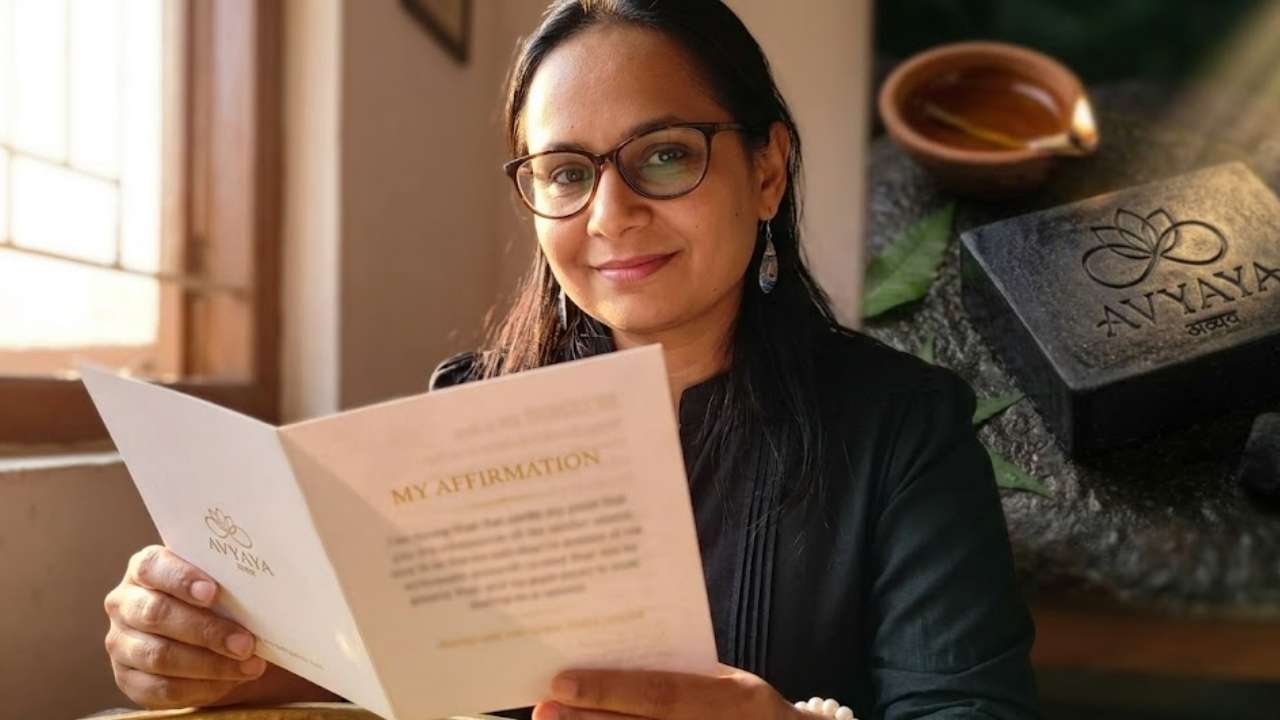
Before your affirmation, perform a brief physical ritual. This does not need to be elaborate; five minutes is sufficient. Warm water. A sacred ritual bar is used slowly and deliberately. The scent of an ingredient that has been used in Indian purification practice for centuries. The body needs a signal that something intentional is beginning. The Avyaya Charcoal Aura Cleansing Soap was designed precisely for this opening; its activated charcoal and eucalyptus combination creates the physical and sensory shift that prepares the nervous system for what follows.
Part 2: Bring the breath to stillness
After the physical practice, before speaking your affirmation, take three slow, deliberate breaths. Exhale longer than you inhale: a 4-count inhale and a 6-count exhale. This is not yoga. This is basic parasympathetic activation, the physiological switch that moves the nervous system from reactive to receptive. Three breaths is enough. You do not need ten minutes of meditation. You need thirty seconds of conscious breathing.
Part 3: Speak the affirmation into a prepared body
Now, and only now, read your affirmations that actually work aloud. Not in your mind. Aloud. The voice carries vibration into the body in a way that silent repetition does not. In mantra tradition, the spoken word (vak) is considered a creative force of sound that shapes reality. Neuroscience agrees: speaking activates multiple brain regions simultaneously, creating a richer, more embodied encoding of the words. Read it three times. Let the third reading land differently from the first. It will.
This is the complete Avyaya method. Physical preparation. Breath. Voice. It takes under ten minutes. It works because it works with your biology, not against it.
Explore the full Avyaya Affirmations That Actually Work Universe here; every affirmation card in the range is hand-selected for the specific ritual it accompanies.
Your Affirmations That Actually Work for Each Ritual: A Complete Guide by Intention
Each Avyaya ritual collection carries its own affirmation, chosen to align with the specific energetic intention of the practice. Here is how to work with each one:
Clarity and Protection: Charcoal Aura Cleansing Ritual
“I am clear. I am protected. I release what does not serve me and begin this day with a clean and radiant aura.”
Use these affirmations that actually work on mornings when you feel energetically heavy, overwhelmed, or in need of a strong, clear beginning. Paired with the physical cleansing ritual, the act of washing amplifies the energetic release the words are declaring.
Abundance: Swarna Shuddhi Ritual
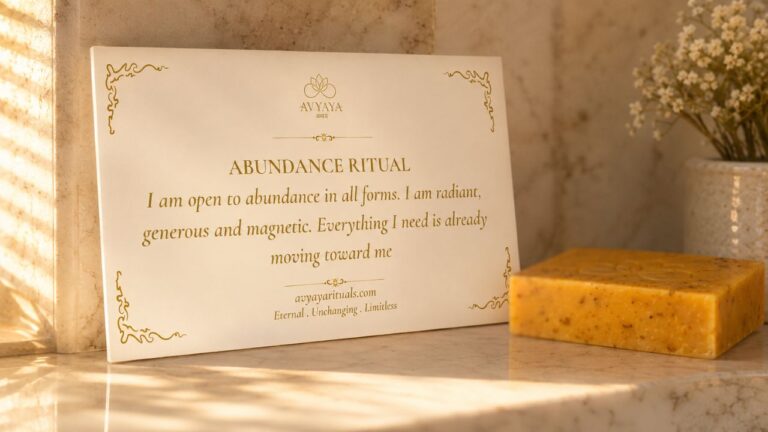
“I am open to abundance in all its forms. I am radiant, generous, and magnetic. Everything I need is already moving toward me.”
Use this affirmation before any auspicious beginning, a new project, a financial decision, or a day that requires you to show up fully. The golden ingredients of haldi and kesar create a physical resonance with abundance that the affirmation lands into.
Love and Self-Care: Rose Aura Ritual
“I am worthy of love, care, and sacred attention. I pour into myself so I may pour into the world. I am enough, exactly as I am.”
This is the most important affirmation for anyone who gives more than they receive. Use it on mornings when the self-critic is loudest. The gentleness of the physical rose ritual creates the exact internal state the words require.
Rest: Lavender Calming Ritual
“I give myself full permission to rest. I release the day with gratitude. In stillness, I am restored. Tomorrow begins in tonight’s peace.”
This is an evening affirmation; use it at the close of the day rather than the opening. The body’s preparation (warm water, lavender, deliberate slowing) creates the receptive state for a permission that many people genuinely struggle to give themselves.
Devotion: Panchgavya Diya Ritual
“I am held by the light of my ancestors. In devotion, I am never alone. The flame I light today connects me to the sacred fire that has always burned.”
Use this affirmation during your morning pooja or any moment of lighting a flame. The act of fire as an ancient witness across every tradition gives this affirmation a weight that words read in silence cannot carry.
Browse the complete Avyaya ritual collection to find the practice that belongs to your morning.
What Happens When You Practise the Affirmations That Actually Work for Thirty Days
A single morning of this practice will feel different from your usual routine. That is worth noticing.
But the transformation that affirmations that actually work are capable of producing happens over time. Not because the words are magic, but because you are showing up every morning, in a prepared body, speaking something true about who you are becoming, and that showing up compounds.
By day seven, the ritual feels natural rather than effortful. By day fourteen, you notice the affirmation arriving in your mind during the day unbidden, in a moment when you need it. By day thirty, something has shifted in the baseline. Not dramatically. Not all at once. But the internal voice that used to contradict the affirmation has grown quieter. The body that used to hold the words at arm’s length has begun to let them in.
This is what Vedic tradition meant by sankalpa. Not a wish made once. A vow renewed every morning, in a prepared body, with a voice that means it.
The sacred morning ritual is not the backdrop to your affirmation practice. It is the reason your affirmation practice will finally work.
If you would like to begin, explore the Avyaya ritual collections here. Every product arrives with its affirmation card, hand-selected, ready for your morning.
FAQs about Affirmations That Actually Work
How long does it take for affirmations that actually work to work?
With the right method, physical preparation, breath, and spoken repetition, most people notice a shift in how the affirmations that actually work feel within the first week. A meaningful change in underlying belief patterns typically takes 21 to 30 days of consistent daily practice. The neuroscience of habit formation supports this timeline: new neural pathways require repeated activation over several weeks before they become the brain’s default. [Link to NCBI research on habit formation and neuroplasticity]
Do affirmations that actually work, work if you do not believe them yet?
Yes, and this is the most important thing to understand about the practice. You do not need to fully believe an affirmation for it to begin working. You need to speak it consistently, in a receptive physical state, until the belief follows the behavior. In Vedic tradition this is the principle of karma yoga: the action precedes the internal shift, not the other way around. Begin the practice. The belief arrives through it.
Can I write my own affirmations instead of using the ones on the cards?
Absolutely. The most effective affirmations that actually work are always present tense (I am, not I will be), specific to your actual intention, and emotionally resonant for you personally. The Avyaya affirmation cards are starting points, invitations into the practice. If a different word or phrase lands more truly for you, use that instead. The method matters more than the exact words. Visit the Avyaya Affirmations That Actually Work Universe for guidance on building your own practice.